
Umbilical and paraumbilical hernias, Despite sharing some commonalities, Both have their own unique characteristics. Having a Vivid Understanding of These Types of Hernias will play a crucial part in the treatment planning and Diagnosis. In this article, we will Deep dive into the key Differences between paraumbilical hernia and umbilical hernia, their causes, symptoms, complications, treatment options, etc. paraumbilical hernia vs umbilical hernia While both paraumbilical hernias and umbilical hernias involve protrusions near the belly button, their anatomical locations and characteristics set them apart. Paraumbilical hernias typically manifest just above or below the navel, while umbilical hernias directly involve the navel itself. Understanding these subtle differences aids in precise identification and appropriate treatment. Feature Umbilical Hernia Paraumbilical Hernia Location Directly through navel Near navel, but not through ring Age More common in babies/children More common in adults Size Usually smaller Usually larger Risk of complications Higher risk of strangulation Lower risk of strangulation Causes: Let us Have a look at the Major Causes of both Umbilical Hernia and Paraumbilical Hernia Causes of Umbilical Hernia: Umbilical hernias often result from a weakness in the abdominal wall muscles around the navel, allowing abdominal contents to push through. This can be congenital or develop due to factors like obesity or pregnancy. Causes of Paraumbilical Hernia: Paraumbilical hernias, on the other hand, stem from a weakening of the tissue layers just above or below the belly button. This weakening can be influenced by factors such as obesity, multiple pregnancies, or abdominal surgery. In both cases, If you want to know how to find out if you have a Hernia, there are common treatment methods followed by professionals such as the three-finger test. So it is always advised to consult a Hernia Specialist for these procedures. Symptoms: Let us Have a look at the Major Symptoms of both Umbilical Hernia and Paraumbilical Hernia Symptoms of Umbilical Hernia: Recognizable by a visible bulge or swelling near the navel, umbilical hernias may also cause discomfort, particularly when coughing or lifting. In infants, these hernias might close on their own, while adults may require intervention for symptomatic cases. Symptoms of Paraumbilical Hernia: Paraumbilical hernias share the bulging characteristic but may differ in location and size. Individuals might experience varying degrees of pain or tenderness, and the protrusion can be more noticeable when intra-abdominal pressure increases. Complications: Let us have a look at the Complications of Umbilical Hernia and Paraumbilical Hernia Complications of Umbilical Hernia: Although umbilical hernias are generally considered low-risk, complications such as incarceration (where abdominal contents get trapped) or strangulation (involving compromised blood flow) can occur. It’s also important to be aware of conditions like navel displacement symptoms that might be mistaken for hernias. Complications of Paraumbilical Hernia: Paraumbilical hernias may also lead to incarceration or strangulation, necessitating timely intervention. Understanding the unique risks associated with paraumbilical hernias is vital for effective management. Does Umbilical Hernia Cause Pain? An umbilical hernia can cause pain, especially around the navel area. The pain may range from mild discomfort to severe, particularly during activities that strain the abdomen, like lifting, coughing, or straining. The hernia often appears as a soft bulge near the navel, which can be tender to touch. In severe cases, where the hernia becomes incarcerated or strangulated, the pain can be intense and require immediate medical attention. Early diagnosis and treatment are crucial to manage pain and prevent complications. If you suspect an umbilical hernia, consult a healthcare professional. Does Paraumbilical Hernia Cause Pain? A paraumbilical hernia can indeed cause pain, which varies from mild discomfort to severe abdominal pain. The pain is typically localized around the navel and may increase with activities like lifting heavy objects, coughing, or straining during bowel movements. In some cases, the hernia can lead to a noticeable bulge near the navel, which may also be tender to touch. If the hernia becomes incarcerated or strangulated, cutting off blood supply to the affected tissue, the pain can become intense and require immediate medical attention. Early diagnosis and treatment are crucial to prevent complications and alleviate pain. Treatment for Umbilical and Paraumbilical Hernia Let us Deep dive into the Treatment options. Treatment for Umbilical Hernia: The management of umbilical hernias can involve watchful waiting, especially in infants, as these hernias may close spontaneously. However, surgical intervention is recommended for larger or symptomatic cases to prevent complications. Treatment for Paraumbilical Hernia: Paraumbilical hernias may be managed through observation, especially if they are small and asymptomatic. Lifestyle modifications, such as weight management, can be beneficial. Surgical repair may be considered for larger hernias or those causing discomfort. In Both cases, it is advised to consult the Best Hernia Surgeon for treatment. Which surgery is best for paraumbilical hernia and Umbilical Hernia? The best surgical approach for you will depend on various factors, including the size of the hernia, your overall health, and your surgeon’s expertise. Always consult with a healthcare professional for personalized advice. Hernia Type Suitable Surgeries Umbilical Hernia Laparoscopic repair, Open repair Paraumbilical Hernia Laparoscopic repair, Open repair, IPOM repair Laparoscopic repair: This minimally invasive technique involves small incisions and the use of specialized instruments to repair the hernia. It is suitable for both umbilical and paraumbilical hernias. Open repair: This traditional method involves a larger incision and direct access to the hernia. It can be used for both types of hernias, but is more commonly used for larger or complex hernias. IPOM repair: This is a specialized technique for paraumbilical hernias that involves reinforcing the abdominal wall with a mesh implant. Laparoscopic repair is generally preferred due to its benefits, such as less pain, faster recovery, and smaller scars. However, the final decision should be made in consultation with your surgeon. Recovery Time for Paraumbilical Hernia and Umbilical Hernia Post-surgery recovery is a critical aspect of hernia management. The recovery time for both paraumbilical and umbilical hernias depends on various factors, including the size of the hernia and individual healing capacity. Generally, patients can expect a gradual return to normal activities under the guidance of their healthcare

Laparoscopic vs Open surgery hernia
Laparoscopic and open surgery both have advantages and disadvantages it’s based on patient condition and preference it’s chosen laparoscopic vs open surgery hernia In laparoscopic mesh repair short recovery time, and much smaller scars and it also has some drawbacks. In larger hernia or hernia that is present for over a long period of time open, and occasionally needs to convert laparoscopic to open to minimize tissue damage or bleeding Benefits of laparoscopy in hernia? Early recovery, short hospital stay, Early return to work, less postoperative pain, Cosmetically better, decreased incidence of wound complication. Benefits of Open Surgery? Cost effective, easily available at most places, does not require advanced equipment and composite mesh, can be done under regional anesthesia, suitable for larger defects, best option in obstructed and strangulated hernias. Laparoscopic VS open surgery which one to choose? Laparoscopic surgery is best for hernia repair since the patient has early recovery, short hospital stay, is cosmetically better & has less complication. However, in Both cases, it is advised to consult the Best Hernia Surgeon for Treatment. Symptoms of hernia Dragging abdominal pain swelling in the anterior abdominal wall with cough impulse nausea, vomiting & obstipation in case of obstruction/strangulation. Risk factors of hernia? Smoking, Old age, multiparity, chronic cough/constipation, connective tissue disorder Conclusion Laparoscopic surgery is considered to be the better option compared to Open Surgery, Laparoscopic surgery also has many advantages when it comes to the Recovery , complication and Diet after Hernia Surgery . Last updated: March 2026 – This article has been updated with the latest information on hernia diagnosis and laparoscopic surgery options in Chennai. Contact Form NameEmailPhone NoYour MessageBook Consultation Dr. K. Amilthan MBBS., MS., FMAS., FALS. Heal Your Hernia Now: 15+ Years of Experience 3,000+ Surgeries Your Journey to Wellness Begins with us. Book Appointment Edit Template Dr. Amilthan Dr. Amilthan is a renowned laparoscopic hernia surgeon based in Chennai, with over 15+ years of experience in general surgery. He completed his MBBS and MS in General Surgery at Kilpauk Medical College and Government Royapettah Hospital in Chennai. Edit Template All Posts Hernia Blog Herniotomy Surgery A hernia is a bulge or swelling that happens when an organ or tissue pushes through a weak muscle and… Read More Bochdalek Hernia Bochdalek hernia or posterolateral diaphragmatic hernia is prominently a congenital defect, although it can also develop in adults. Bochdalek hernia… Read More Incisional Hernia After Laparoscopic Surgery Incisional hernia after laparoscopic surgery is a condition that can develop when a surgical incision in the abdominal wall does not… Read More Load More End of Content.

Pantaloon Hernia
Hernia Meaning & Hernia Definition The term “hernia” means “rupture” in Latin. A hernia is a condition where an organ or other body parts push through and protrude against a weak muscle or surrounding tissue. There are different types of hernia based on their location in the body and their type (direct or indirect). Pantaloon hernia is one such type of hernia. In this article, let’s look into detail about pantaloon hernia, starting from its causes and symptoms to its treatment methods. Pantaloon hernia meaning Pantaloon Hernia in a Female Pantaloon Hernia is a combination of both direct and indirect hernia, where two hernia sacs from the inguinal and femoral areas are on the same side, divided by the epigastric vessels, resembling “pants.” A pantaloon hernia is a combination of both direct and indirect hernia. Here, two hernia sacs from the inguinal and femoral areas are on the same side. The sacs push through both sides of the inferior epigastric vessels. Over the years there have been medical experts who have classified Pantaloon Hernia in their classification ( Ex. Nyhus Classification of Hernia, Gilbert Classification of Hernia.) It is called a ‘pantaloon’ hernia because it is divided by the epigastric vessels, making it look like ‘pants.’ It is also referred to by many names: Romberg’s hernia, saddlebag hernia, and dual/double hernia. It can be diagnosed through an abdominal CT scan and ultrasound. It is more common in males (5.6%) than in females (1.8%), and it can lead to symptoms such as localized pain, recurrent UTIs, and irreducible swelling. You may be wondering whether Hernia occurs in Females, According to studies, the chances of pantaloon hernia are 5.6% in males and 1.8% in females. That is, a pantaloon hernia is three times more likely to happen in males than females. Almost all inguinal hernias women would get are indirect. So, the chances of them having both direct and indirect hernias are very rare. This resistance to direct hernia in females is mainly due to the strong transversalis fascia in the floor of the inguinal canal. Most hernias in women are treated as indirect hernias unless the diagnosis proves them to be direct hernias Pantaloon Hernia Symptoms Below are some symptoms patients may feel when they have pantaloon hernia. Localized pain and tenderness in the lower parts of the abdomen Recurrent UTIs (Urinary Tract Infections) Irreducible swelling that worsens over time Pantaloon Hernia Complications Complications of Pantaloon Hernia include bowel obstruction, strangulation or incarceration, renal failure, and bladder rupture. Bowel obstruction Bowel obstruction is where there are blockages in the small or large intestine that block food or liquids from passing through. This can be very painful and lead to serious medical conditions. Strangulation/incarceration Strangulation or incarceration in a hernia occurs when the hernia sac constricts the blood supply to the arteries. This can eventually lead to necrosis (tissue death). It is also a serious issue and needs immediate medical assistance. Renal failure Renal failure happens when one or both kidneys are unable to perform their excretory functions and expel waste from the blood. This can lead to issues like diabetes, high blood pressure, etc. Bladder rupture Bladder rupture happens when the hernia sac pushes through the bladder and causes a teat in the bladder. This is a very serious condition and can cause death if left untreated. Pantaloon Hernia Treatment The primary treatment for Pantaloon Hernia is laparoscopic surgery, specifically Total Extra-Peritoneal Repair (TEP) or Transabdominal Pre-peritoneal Repair (TAPP) surgeries. The primary treatment for pantaloon hernia is laparoscopic surgery. It involves the following surgeries. Total Extra-Peritoneal Repair surgery (TEP) Transabdominal Pre-peritoneal Repair surgery (TAPP) The TEP hernia repair surgery is a minimally invasive laparoscopic surgery that is done from outside the abdomen without entering the peritoneum. The TAPP hernia surgery is performed by making an incision on the peritoneum and placing a mesh over the hernia sites. Conclusion Pantaloon hernia is a serious condition where the patient has both direct and indirect hernia. It is best to visit the Best Hernia Surgeon and get treated immediately. Last updated: March 2026 – This article has been updated with the latest information on hernia diagnosis and laparoscopic surgery options in Chennai. Contact Form NameEmailPhone NoYour MessageBook Consultation Dr. K. Amilthan MBBS., MS., FMAS., FALS. Heal Your Hernia Now: 15+ Years of Experience 3,000+ Surgeries Your Journey to Wellness Begins with us. Book Appointment Edit Template FAQ’s 1. What are the chances of pantaloon hernias in males and females? According to studies, men have a 5.6% chance of getting a pantaloon hernia, while women have a 1.8% chance of having this hernia. That is, men are three times more likely to get pantaloon hernia than women. 2. What are the different types of hernias? There are different types of hernia based on the location of the hernia and the type (direct or indirect). Some major types of hernia are femoral hernia, Inguinal hernia, Hiatal hernia, Scrotal hernia and Umbilical hernia. 3. What is a triangle of doom? The triangle of doom is an anatomical triangle that is bound by the peritoneal sac, vas deferens, and testicular vessels. The external iliac artery and vein can be found in this area. Dr. Amilthan Dr. Amilthan is a renowned laparoscopic hernia surgeon based in Chennai, with over 15+ years of experience in general surgery. He completed his MBBS and MS in General Surgery at Kilpauk Medical College and Government Royapettah Hospital in Chennai. Edit Template All Posts Hernia Blog Herniotomy Surgery A hernia is a bulge or swelling that happens when an organ or tissue pushes through a weak muscle and… Read More Bochdalek Hernia Bochdalek hernia or posterolateral diaphragmatic hernia is prominently a congenital defect, although it can also develop in adults. Bochdalek hernia… Read More Incisional Hernia After Laparoscopic Surgery Incisional hernia after laparoscopic surgery is a condition that can develop when a surgical incision in the abdominal wall does not… Read More Load More End of Content.

How to prevent hernia
Hernia is a condition where an organ or part of your body protrudes through a weak muscle wall or tissue structure surrounding it. This majorly happens when your muscles are not strong enough to hold it in its place. There are several treatment options you can opt for if you have a hernia. But wouldn’t it be better if you could prevent hernia even before it happens? This can save your body from unnecessary pain and treatments and also save you money. So, to help you out with that, we have discussed some 15 ways you can follow to maintain a healthy lifestyle and prevent the chances of getting a hernia. Continue reading to learn more. Top 14 Ways for Preventing Hernia There are numerous techniques to prevent certain forms of hernias, and we have listed the top 15 ways below. 1) Exercise regularly Regular exercises are key to toning your body and reducing pressure on your abdominal muscles. According to studies, overweight and obese people are more prone to hernias. A good dose of regular moderate exercise can help you maintain your health and reduce the risks of hernia. 2) Avoid Heavy Coughing Chronic or heavy coughing is one of the main causes of hernia. It can put too much strain on the abdominal wall and cause the organs to bulge through them. Consult a doctor and try treating it as early as possible to prevent chances of hernia. 3) Avoid Smoking Chainsmokers are more prone to hernia than non-smokers. This is due to one of the most common side effects of smoking: chronic & heavy coughing. Smoking inhibits cell growth and causes heavy coughing. This can strain the muscles and cause hernia. 4) Avoid Alcohol Regular alcohol consumption can weaken your liver and affect the inner layer of your abdominal wall. This can cause the organs to push through the wall and cause hernia. So limit alcohol consumption as much as you can. 5) Follow a proper Diet Your food plays an important role in maintaining your health. Whether you are in good health or sick, your diet and lifestyle will majorly contribute to it. So, try maintaining a proper diet with all the essential nutrients and avoid eating unhealthy foods like junk, processed, and fried foods. They are not only unhealthy but also increase the chances of obesity, which in turn increases the chances of hernia. 6) Wear comfortable clothes Wearing too tight clothes can strain your muscles and cause a hernia. So, try to wear loose-fitting clothes as often as you can. 7) Avoid Straining while using the Restroom As you know, a hernia occurs when an organ protrudes from a muscle or tissue structure. This mainly happens when you strain your muscles too much. This can force the organs to move out of their place and poke through other places. And so avoid straining too much while using the restroom. It not only causes hernia but also causes rectal bleeding, anal fissure, etc. 8) Cure Complications Health complications like recurrent sneezing, constipation, and coughing can weaken your abdominal muscles and cause hernia. So, try curing them as early as possible. 9) Warm up before the workout You might be too excited to start your workouts every day. But never do them without warming up your body. Whether you exercise in the morning or in the evening, putting too much sudden pressure on your body can strain your muscles. This can cause hernia. So always warm up before you start your daily exercises. 10) Maintain Good posture while heavy lifting Weight lifting is an effective exercise to reduce excess fat and maintain your body. But there is a certain way you should do it. You should always bend your knees and not your stomach during weight lifting. Similarly, you should keep many such postures right while doing the exercise. Incorrect posture can strain your muscles and increase the risk of hernia. 11) Practice yoga Practicing yoga for hernia and other relaxation exercises is an excellent way to relax your body and muscles. Specific yoga poses can help strengthen weak muscles and improve overall well-being. 12) Try to do Less intensive Workout High-intensity workouts can cause muscle tear and injury. So, it is best to do less intensive exercise or yoga to prevent hernia. If you wish to practice high-intensity workouts, make sure you only do it under the supervision of a fitness coach. 13) Exercise to strengthen the weak muscles. Regular exercise helps you build and improve your muscle strength. Daily moderate-intensity exercise can strengthen weak muscles, especially your core and abdominal muscles. 14) Improve Your BMI. Maintaining your body weight and following a healthy lifestyle is the first and foremost factor that helps you prevent several health complications. Studies show that overweight and obese people are more prone to hernias than people with normal weight. So, try improving your BMI (Body Mass Index) to prevent chances of hernia. Conclusion Above are the 15 tips you can follow to reduce the chances of hernias and maintain a healthy body. They are mostly simple and can be easily incorporated into your daily routine. So try following them and watch as they make you more healthy and lively. If you suspect you have a hernia, it is best not to delay and consult a laparoscopic surgeon immediately. The quicker you diagnose the issue the quicker it can be treated Before starting any prevention activities and lifestyle changes it is advised to consult the Best Hernia Surgeon to get a clear understanding that may help more in the prevention of hernia Last updated: March 2026 – This article has been updated with the latest information on hernia diagnosis and laparoscopic surgery options in Chennai. Contact Form NameEmailPhone NoYour MessageBook Consultation Dr. K. Amilthan MBBS., MS., FMAS., FALS. Heal Your Hernia Now: 15+ Years of Experience 3,000+ Surgeries Your Journey to Wellness Begins with us. Book Appointment Edit Template FAQ’s 1) Can you heal a hernia with exercise? Exercise can help

Which Doctor To Consult For Hernia Specialist In Chennai?
Which Doctor should you consult for Hernia specialist in Chennai? If you are experiencing the signs of a hernia, choosing the right specialist is your first step toward a smooth recovery. While both general surgeons and specialized hernia surgeons can evaluate your condition, understanding their specific expertise will help you make an informed decision. Understanding Hernia Hernia happens when a part of your body pushes through and bulges against a weak muscle or the surrounding tissue wall that contains it. It usually develops between the chest and hip area. Hernia is not usually painful and does not cause any major issues. But, left untreated, it may cause pain and lead to serious issues like necrosis (tissue death). To avoid such complications, it is essential to confirm hernia through a proper diagnosis. It is best to get your hernia treated during its early development stages. But how do you choose a doctor to do the surgery for you? Continue reading this article to understand which doctor you should consult for hernia and how to choose them. What Type of Doctor Treats Hernias? If you want to get your hernia treated, you should look for general surgeons who specialize in performing laparoscopic surgeries. Laparoscopic surgeries are minimally invasive surgeries where small incisions of around 1–1.5 cm are made on the abdomen or other parts of the body. A tube with a lens and camera is inserted through the incision, using which doctors will treat the hernia. General surgeons are usually trained to perform surgeries on most body parts, including the gastrointestinal tract, breast, abdomen, skin, endocrinal tissue, etc. They diagnose and provide presurgical, surgical, and post-surgical care for the patients. How to Choose the Right Surgeon for Hernia? Hernia is a very important surgery. So, be informed about every step of the process. Ensure you choose the best hernia surgeon to perform the surgery on you. Here are some points you can follow while choosing your hernia doctor. Research the ailment, its treatment options and methods, and the doctors who perform it in your area. Choose a doctor who is highly trained and is known for their high success rates in treating hernia. Do a thorough background check on the doctors: educational qualification, certification, skills, and expertise in the area. Check the qualifications of the Hernia doctor While looking for a hernia surgeon, make sure they are qualified for the role and have all the necessary educational qualifications to perform the surgery. Belo are the educational qualifications that the hernia doctor you choose should have. Bachelor of Medicine and a Bachelor of Surgery (MBBS) Indian Board Certification Fellowship in a college of surgeons Practice in an Accredited Health Care Facility MS (Masters in Surgery) Check the doctor’s experience An experienced and well-trained surgeon can do your surgery far better with less to no complications. So, check the doctor’s experience handling hernia cases and identify their success rate in the treatment. Check the key skills of the Hernia surgeon Ensure the doctor is knowledgeable about the most recent hernia treatments and medications before choosing them. They must also have the necessary training to handle any issues that may emerge during the surgery. You can be confident you’ll get excellent medical care by conducting comprehensive research and choosing the Best Hernia Surgeon. Check the reviews of previous patients Speak with previous patients who have already undergone hernia surgery from the same doctor you have decided to choose. This can help you make an informed choice. You may also read patient testimonials online on various platforms to confirm that a well-trained professional will treat you. Conclusion Hernias might cause more serious problems if they are not treated. To prevent Hernia and complications, it is best to visit a laparoscopic surgeon and undergo surgery at the earliest stage of its development. Make an appointment with the best hernia surgeon as soon as possible and get your hernia treated. Last updated: March 2026 – This article has been updated with the latest information on hernia diagnosis and laparoscopic surgery options in Chennai. Contact Form NameEmailPhone NoYour MessageBook Consultation Dr. K. Amilthan MBBS., MS., FMAS., FALS. Heal Your Hernia Now: 15+ Years of Experience 3,000+ Surgeries Your Journey to Wellness Begins with us. Book Appointment Edit Template FAQ’s 1. What type of doctor is best for hernia? A hernia typically appears as a noticeable bulge or swelling in the affected area. For instance, a small bulge in the groin area caused by an inguinal hernia may be felt or seen when standing or coughing. An umbilical hernia at the belly button may protrude visibly when you cough or strain. 2. How do I check myself for a hernia? A hernia typically appears as a noticeable bulge or swelling in the affected area. For instance, a small bulge in the groin area caused by an inguinal hernia may be felt or seen when standing or coughing. An umbilical hernia at the belly button may protrude visibly when you cough or strain. 3. Which hernia is more serious? When protruding tissue can’t be forced back into place, it develops into an incarcerated hernia, which causes persistent pressure or discomfort on the body. This can lead to a strangulated hernia where the area bulging through loses blood supply. This can also cause serious issues like necrosis (tissue death). 4. Can a doctor fix a hernia without surgery? You may be able to delay surgery by taking medications and other minor treatments. But if you wish to permanently repair hernia, surgery is the only way. Dr. Amilthan Dr. Amilthan is a renowned laparoscopic hernia surgeon based in Chennai, with over 15+ years of experience in general surgery. He completed his MBBS and MS in General Surgery at Kilpauk Medical College and Government Royapettah Hospital in Chennai. Edit Template All Posts Hernia Blog MAYDL’S HERNIA A hernia occurs when an organ or any other part of your body pushes through the muscle and surrounding tissue… Read More Gilbert Classification of Hernia An inguinal hernia occurs when the organs
Which Doctor To Consult For Hernia?
Which Doctor should you consult for Hernia? You can Consult a general surgeon or a hernia specialist for evaluation and Hernia treatment. It would help if you first gained valuable insights from the Hernia specialist. Understanding Hernia Hernia happens when a part of your body pushes through and bulges against a weak muscle or the surrounding tissue wall that contains it. It usually develops between the chest and hip area. Hernia is not usually painful and does not cause any major issues. But, left untreated, it may cause pain and lead to serious issues like necrosis (tissue death). To avoid such complications, it is essential to confirm hernia through a proper diagnosis. It is best to get your hernia treated during its early development stages. But how do you choose a doctor to do the surgery for you? Continue reading this article to understand which doctor you should consult for hernia and how to choose them. What Type of Doctor Treats Hernias? If you want to get your hernia treated, you should look for general surgeons who specialize in performing laparoscopic surgeries. Laparoscopic surgeries are minimally invasive surgeries where small incisions of around 1–1.5 cm are made on the abdomen or other parts of the body. A tube with a lens and camera is inserted through the incision, using which doctors will treat the hernia. General surgeons are usually trained to perform surgeries on most body parts, including the gastrointestinal tract, breast, abdomen, skin, endocrinal tissue, etc. They diagnose and provide presurgical, surgical, and post-surgical care for the patients. How to Choose the Right Surgeon for Hernia? Hernia is a very important surgery. So, be informed about every step of the process. Ensure you choose the best hernia surgeon to perform the surgery on you. Here are some points you can follow while choosing your hernia doctor. Research the ailment, its treatment options and methods, and the doctors who perform it in your area. Choose a doctor who is highly trained and is known for their high success rates in treating hernia. Do a thorough background check on the doctors: educational qualification, certification, skills, and expertise in the area. Check the qualifications of the Hernia doctor While looking for a hernia surgeon, make sure they are qualified for the role and have all the necessary educational qualifications to perform the surgery. Belo are the educational qualifications that the hernia doctor you choose should have. Bachelor of Medicine and a Bachelor of Surgery (MBBS) Indian Board Certification Fellowship in a college of surgeons Practice in an Accredited Health Care Facility MS (Masters in Surgery) Check the doctor’s experience An experienced and well-trained surgeon can do your surgery far better with less to no complications. So, check the doctor’s experience handling hernia cases and identify their success rate in the treatment. Check the key skills of the Hernia surgeon Ensure the doctor is knowledgeable about the most recent hernia treatments and medications before choosing them. They must also have the necessary training to handle any issues that may emerge during the surgery. You can be confident you’ll get excellent medical care by conducting comprehensive research and choosing the Best Hernia Surgeon. Check the reviews of previous patients Speak with previous patients who have already undergone hernia surgery from the same doctor you have decided to choose. This can help you make an informed choice. You may also read patient testimonials online on various platforms to confirm that a well-trained professional will treat you. Conclusion Hernias might cause more serious problems if they are not treated. To prevent Hernia and complications, it is best to visit a laparoscopic surgeon and undergo surgery at the earliest stage of its development. Make an appointment with the best hernia surgeon as soon as possible and get your hernia treated. Contact Form NameEmailPhone NoYour MessageBook Consultation Dr. K. Amilthan MBBS., MS., FMAS., FALS. Heal Your Hernia Now: 15+ Years of Experience 3,000+ Surgeries Your Journey to Wellness Begins with us. Book Appointment Edit Template FAQ’s 1. What type of doctor is best for hernia? A hernia typically appears as a noticeable bulge or swelling in the affected area. For instance, a small bulge in the groin area caused by an inguinal hernia may be felt or seen when standing or coughing. An umbilical hernia at the belly button may protrude visibly when you cough or strain. 2. How do I check myself for a hernia? A hernia typically appears as a noticeable bulge or swelling in the affected area. For instance, a small bulge in the groin area caused by an inguinal hernia may be felt or seen when standing or coughing. An umbilical hernia at the belly button may protrude visibly when you cough or strain. 3. Which hernia is more serious? When protruding tissue can’t be forced back into place, it develops into an incarcerated hernia, which causes persistent pressure or discomfort on the body. This can lead to a strangulated hernia where the area bulging through loses blood supply. This can also cause serious issues like necrosis (tissue death). 4. Can a doctor fix a hernia without surgery? You may be able to delay surgery by taking medications and other minor treatments. But if you wish to permanently repair hernia, surgery is the only way. Dr. Amilthan Dr. Amilthan is a renowned laparoscopic hernia surgeon based in Chennai, with over 15+ years of experience in general surgery. He completed his MBBS and MS in General Surgery at Kilpauk Medical College and Government Royapettah Hospital in Chennai. Edit Template All Posts Hernia Blog MAYDL’S HERNIA A hernia occurs when an organ or any other part of your body pushes through the muscle and surrounding tissue… Read More Gilbert Classification of Hernia An inguinal hernia occurs when the organs push through and bulge against the weak muscles of the abdomen. An effective… Read More Difference Between Hernia And Appendix Whether you have a hernia or appendicitis, the main symptom you will experience is stomach pain. So, it might be… Read More

Infraumbilical Incision
When it comes to surgical procedures, a special kind of cut below your belly button, called an infraumbilical incision, takes center stage. This blog takes a friendly stroll through the ins and outs of the low belly button cut, exploring when surgeons use it, how it’s different from other cuts, and the specifics of an infraumbilical midline incision. Infraumbilical Incision So, what’s this infraumbilical incision all about? It’s like a secret door surgeons use to get to the lower belly without causing too much fuss. Imagine a tiny, well-placed cut just below your belly button – that’s the infraumbilical incision. It’s like the backstage pass for surgeries that need a peek into the lower belly. Since these types of issues require expert guidance it is advised to consult the best Hernia surgeon for Treatments. When Do Surgeons Use Infraumbilical Incisions? Surgeons pick the infraumbilical incision when they need to do surgeries in the lower belly. Think about fixing hernias, removing appendices, or handling women’s health matters. The choice of this cut is like choosing the right tool for a job – it’s about getting where they need to be with precision. How Does This Incision Differ from Other Types of Incisions? Now, let’s talk about what makes this cut special. Unlike other cuts that might go in different parts of your belly, the infraumbilical incision zooms in on the lower belly. It’s like a surgeon’s secret code to reach exactly where they need to be without disturbing too much around it. Precision is the name of the game. Difference Between Infraumbilical Incision and Infraumbilical Midline Incision Okay, so there’s another version called the infraumbilical midline incision. Sounds fancy, right? Well, it’s pretty simple. The infraumbilical incision might go sideways or at a slant, while the midline one goes straight down. Both are like secret passages, but the midline incision takes the straight path. Conclusion To sum it up, the low belly button cut, aka infraumbilical incision, is like a surgeon’s special entrance to the lower belly world. When surgeons need to fix things down there, they choose this cut for its accuracy and minimal disturbance. It’s a bit like having a secret code for the right door in a big building – precision matters. In conclusion, understanding the low belly button cut helps you see the thoughtfulness behind surgical planning. It’s like peeking behind the curtain of a well-orchestrated performance. So, the next time you talk surgery with your healthcare team, you’re armed with a bit of insider knowledge, making the journey to better health a collaborative adventure. Contact Form NameEmailPhone NoYour MessageBook Consultation Dr. K. Amilthan MBBS., MS., FMAS., FALS. Heal Your Hernia Now: 15+ Years of Experience 3,000+ Surgeries Your Journey to Wellness Begins with us. Book Appointment Edit Template Dr. Amilthan Dr. Amilthan is a renowned laparoscopic hernia surgeon based in Chennai, with over 15+ years of experience in general surgery. He completed his MBBS and MS in General Surgery at Kilpauk Medical College and Government Royapettah Hospital in Chennai. Edit Template All Posts Hernia Blog MAYDL’S HERNIA A hernia occurs when an organ or any other part of your body pushes through the muscle and surrounding tissue… Read More Gilbert Classification of Hernia An inguinal hernia occurs when the organs push through and bulge against the weak muscles of the abdomen. An effective… Read More Difference Between Hernia And Appendix Whether you have a hernia or appendicitis, the main symptom you will experience is stomach pain. So, it might be… Read More Load More End of Content.

Appendix in a Femoral Hernia
In the intricate landscape of hernias, a unique scenario unfolds when the appendix becomes entwined in a femoral hernia. This exploration delves into the basics, shining a spotlight on the presence of the appendix in femoral hernias and unraveling the intricacies of this less-common but noteworthy condition. Appendix in a Femoral Hernia Picture this: a femoral hernia housing the appendix. It’s a situation where the small, finger-like organ called the appendix finds an unexpected home in the protrusion of the femoral hernia. This occurrence adds a layer of complexity to the already diverse world of hernias. Some of you may even think about the Difference Between Hernia and Appendix Is Appendix in Femoral Hernia a Common Condition? The presence of the appendix in a femoral hernia is not as common as other types of hernias. Femoral hernias themselves are less prevalent compared to inguinal hernias, and when the appendix is involved, it adds a distinctive dimension. While femoral hernias are more common in women, the occurrence of the appendix within them is relatively rare. What is the Name of a Femoral Hernia Containing the Appendix? When the appendix takes residence in a femoral hernia, it is often referred to as a “De Garengeot hernia.” Named after the French surgeon Rene Jacques Croissant de Garengeot, who first documented this unusual occurrence in the 18th century, this type of hernia with the appendix is a distinct subset within the realm of hernias. Treatment Addressing a femoral hernia that contains the appendix involves surgical intervention. The goal is to reduce the hernia, return the displaced appendix to its normal position, and reinforce the weakened area to prevent recurrence. This surgical procedure requires precision and expertise due to the involvement of the appendix. So it is advised to consult the Best Hernia Surgeon to treat this issue. Conclusion The appendix finding its way into a femoral hernia adds a layer of complexity to an already diverse spectrum of hernias. While it is not a common occurrence, the uniqueness of this situation is encapsulated in the term “De Garengeot hernia.” Recognizing and addressing such hernias involve a tailored approach, with surgical intervention being the primary course of action to ensure a resolution. In conclusion, the presence of the appendix in a femoral hernia is a fascinating aspect of surgical cases. Understanding this less-common condition sheds light on the intricacies surgeons navigate in the realm of hernia repairs. As we unveil these complexities, it reinforces the importance of tailored treatments and ongoing exploration in the ever-evolving landscape of medical knowledge. Contact Form NameEmailPhone NoYour MessageBook Consultation Dr. K. Amilthan MBBS., MS., FMAS., FALS. Heal Your Hernia Now: 15+ Years of Experience 3,000+ Surgeries Your Journey to Wellness Begins with us. Book Appointment Edit Template Dr. Amilthan Dr. Amilthan is a renowned laparoscopic hernia surgeon based in Chennai, with over 15+ years of experience in general surgery. He completed his MBBS and MS in General Surgery at Kilpauk Medical College and Government Royapettah Hospital in Chennai. Edit Template All Posts Hernia Blog MAYDL’S HERNIA A hernia occurs when an organ or any other part of your body pushes through the muscle and surrounding tissue… Read More Gilbert Classification of Hernia An inguinal hernia occurs when the organs push through and bulge against the weak muscles of the abdomen. An effective… Read More Difference Between Hernia And Appendix Whether you have a hernia or appendicitis, the main symptom you will experience is stomach pain. So, it might be… Read More Load More End of Content.
Sibson Hernia
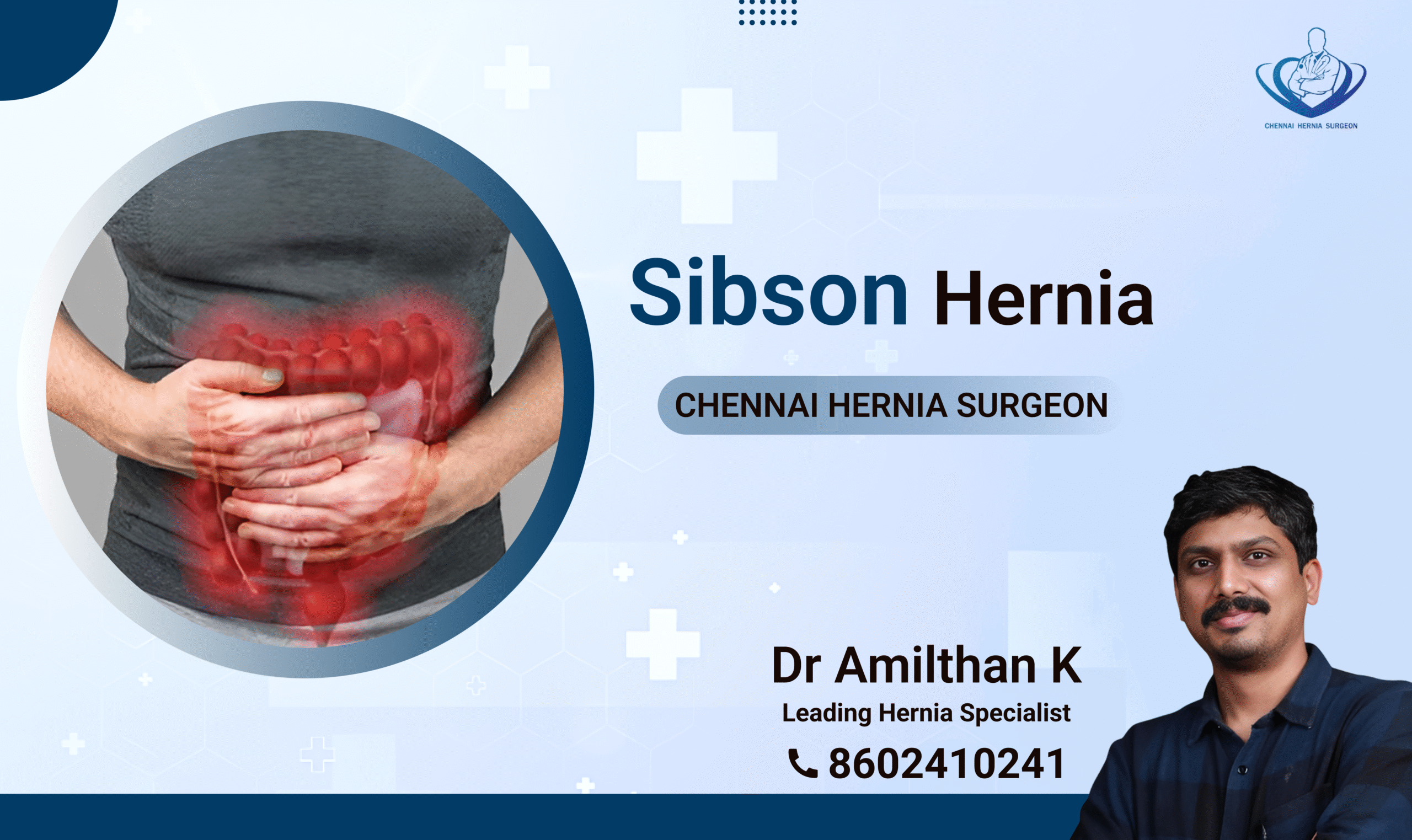
You might have commonly heard of the term “hernia.” Hernia is a bulge in the body that occurs when a part of the body protrudes through the muscle or tissues surrounding it. Most people have only heard about hernias that affect the abdomen or groin areas. But did you know that hernias can also affect your lungs? Yes, some people can also have lung hernia, commonly called Sibson hernia. This article discusses what a sibson hernia is, along with its cause, symptoms, and treatments. Continue reading to learn more about them. What is Sibson hernia? Sibson hernia, or lung hernia, is a hernia that occurs in your lung cavity. It is the condition where the hernia protrudes outside of the thoracic wall. Sibson hernia is very rare and can either be caused by congenital or external trauma. Lung hernias are often not life-threatening and don’t need immediate medical intervention. They are easier to locate, diagnose, and treat than other hernias. Sibson hernia causes According to studies, the chances of a person getting this type of hernia can be due to two factors. Congenital hernia (Hernia since birth) Almost 20% of patients get lung hernia due to congenital factors. They can be caused if the neck muscles or suprapleural membrane (Sibson’s fascia) is weak. This condition is very rare; fewer than one in five cases have been reported. Hernia caused by external factors When it comes to Sibson hernia, almost 80% of patients get them as a result of chest trauma, thoracic surgeries, or some pulmonary diseases like frequent coughs, asthma, etc. Frequent asthma or coughs can cause intra-thoracic pressure, forcing the lung to poke out of the thoracic cavity. Below are some areas of the body where you can get Sibson hernia. Between the ribs (intercostal) Near the neck (cervical) Near the vertebrae (para vertebral) Near the sternum (parasternal) Sibson hernia symptoms Sibson hernia can be both symptomatic and asymptomatic. Below are some symptoms one can experience with Sibson hernia. A visible protrusion between the ribs or near the neck. For some, the hernia will be more prominent when they sough or put strain on the lungs. Some patients might have a chronic cough, dysphagia (having trouble swallowing), or neuropathic pain (nerve pain). People with no visible hernia symptoms (asymptomatic) need to get a Chest X-ray to identify the issue. A physical examination like the Valsalva maneuver can also be done to identify the hernia. These tests are often done for another reason, and hernias are only found after performing the test. since these examinations require experts to consult it is essential for the patients to know which Doctor to consult for Hernia Sibson hernia treatment The majority of lung hernias are asymptomatic with low incarceration risks. So, surgical repair are very uncommon. The patients can be treated with some bed rest, cough suppressants, analgesic pain medications, and other basic treatments. If the patient has a severe lung hernia, a surgical procedure can be performed either in an open or thoracoscopic manner. Conclusion Lung hernia is not a very serious issue. But it is best not to be careless about it and seek medical help immediately. You can seek an expert Hernia Surgeon in your area to consult and treat the issue. Contact Form NameEmailPhone NoYour MessageBook Consultation Dr. K. Amilthan MBBS., MS., FMAS., FALS. Heal Your Hernia Now: 15+ Years of Experience 3,000+ Surgeries Your Journey to Wellness Begins with us. Book Appointment Edit Template FAQ’s 1. How do you treat a sibson or lung hernia? The majority of lung hernias are asymptomatic with low incarceration risks. So, surgical repair are very uncommon. The patients can be treated with bed rest, cough suppressants, analgesic pain medications, and other basic treatments. If the patient has a severe lung hernia, a surgical procedure can be performed either in an open or thoracoscopic manner. 2. What are the two ways one can get a lung hernia? Lung hernia or sibson hernia is very rare and can either be caused by congenital or external trauma. Lung hernias are often not life-threatening and don’t need immediate medical intervention. They are easier to locate, diagnose, and treat than other hernias. 3. How do you identify an asymptomatic lung hernia? People with no visible hernia symptoms (asymptomatic) need to get a Chest X-ray to identify the issue. A physical examination like the Valsalva maneuver can also be done to identify the hernia. These tests are often done for another reason, and hernias are only found after performing the test. Dr. Amilthan Dr. Amilthan is a renowned laparoscopic hernia surgeon based in Chennai, with over 15+ years of experience in general surgery. He completed his MBBS and MS in General Surgery at Kilpauk Medical College and Government Royapettah Hospital in Chennai. Edit Template All Posts Hernia Blog MAYDL’S HERNIA A hernia occurs when an organ or any other part of your body pushes through the muscle and surrounding tissue… Read More Gilbert Classification of Hernia An inguinal hernia occurs when the organs push through and bulge against the weak muscles of the abdomen. An effective… Read More Difference Between Hernia And Appendix Whether you have a hernia or appendicitis, the main symptom you will experience is stomach pain. So, it might be… Read More Load More End of Content.

Travel after Hernia surgery
Have you recently had your hernia surgery? Then, the dos and don’ts you must follow post-surgery can be very confusing for you. And the question that most people have is, “Can I travel after hernia surgery?” Most people don’t know whether they can travel after a hernia surgery. So, if you want to know whether you can travel or fly after the surgery and learn how to prevent it from reappearing, read this article. Can I travel after hernia surgery? Minor surgery allows for cautious travel, major surgery necessitates avoiding travel for a few days The answer to this question mainly depends on the level of your hernia surgery. If you had a minor hernia surgery, you can rest for some time and get discharged home on the day of the surgery. Traveling is okay, but it is best to be cautious and careful during traveling. Don’t drive and ask your family or friends to drive instead. But, if you had a major surgery, traveling should be strictly avoided for a few days. You will be asked to stay and rest in the hospital for at least two days after a major surgery. Your doctors also advise you to abstain from heavy lifting or strenuous exercises and wear comfortable clothes after hernia surgery for a few weeks. Can You Fly After a Hernia Surgery? Flying immediately after surgery is not recommended due to potential risks like cabin pressure and luggage handling No, most doctors don’t recommend flying immediately after a hernia surgery. Your body needs time to recover from the surgery. The cabin pressure in the plane will also be different from the pressure on the ground. This can cause issues like Deep Vein Thrombosis (DVT), infections, etc. Most airlines won’t allow you to fly immediately after surgery or unless you have your doctor’s approval. So, your doctor decides whether you and your body are capable of flying or not. What are the risks of flying with a hernia? >Risks of flying with a hernia include strain from lifting luggage and the impact of low cabin pressure on the body. >Risks of flying with a hernia include strain from lifting luggage and the impact of low cabin pressure on the body. There are two main reasons doctors don’t recommend flying for a few days or weeks after hernia surgery. The first is carrying or moving your luggage. If you are flying, you might be required to move your luggage during check-in and boarding. This is not recommended after a hernia surgery as it can strain your muscles. The second reason is the plane’s cabin pressure. Even if you evaded the first cause by having your family move your luggage, you can’t escape the plane’s low cabin pressure. It can cause gasses in your body and organs, making them expand in size. This can enlarge the hernia and cause bowel blockage or even hernia strangulation. What happens if your hernia worsens while traveling? If your condition worsens while traveling, seek immediate medical attention. Your doctor will allow you to fly when your condition has stabilized. But sometimes, your condition might worsen when you are flying. It can also be life-threatening if immediate medical attention is not given. During such cases, it is best to use a medical flight and visit the Best Hernia Surgeon as soon as possible. How to prevent hernia from coming back after the operation? This is a common concern in many patients undergoing hernia surgeries. Some hernias are notorious for reappearing sometime after surgery. Here are some measures you can take post-surgery to prevent hernia from reappearing. Strictly follow the diet After the Hernia Surgery according to doctor or dietician has drafted for you. Avoid heavy lifting and strenuous activities for some days or weeks after the surgery. Protein helps with faster tissue healing. Ensure your diet is high in protein. Intake high-fiber and fluids to prevent strain while using the restroom. Strictly avoid smoking and excess alcohol consumption. Keep your body weight in check. Conclusion A Hernia Health education is needed When you undergo a Hernia Surgery, Whether you can travel or not after a hernia surgery depends on your condition and your doctor’s approval. Always consult your doctor if you wish to travel and take the necessary precautions to avoid complications during your journey. Your health is more important than anything. So, take care of your body and focus on recovering after your surgery. Contact Form NameEmailPhone NoYour MessageBook Consultation Dr. K. Amilthan MBBS., MS., FMAS., FALS. Heal Your Hernia Now: 15+ Years of Experience 3,000+ Surgeries Your Journey to Wellness Begins with us. Book Appointment Edit Template FAQ’s 1. How long is bed rest necessary after a hernia surgery? Most patients feel well enough to resume daily activities, such as driving and returning to work within a few days. However, it is best to limit activities to two weeks to allow for sufficient recovery. Patients should not exercise or undertake any heavy lifting for the first two weeks following hernia surgery. 2. What are some restrictions after a Hernia surgery? Patients should follow the following restrictions to allow proper recovery after a hernia surgery. No strenuous exercise or heavy lifting No smoking or drinking No intake of unhealthy foods like processed or junk foods 3. Is it okay to walk after a Hernia surgery? Though most doctors restrict strenuous activities, you can do some basic activities like walking, climbing stairs, mowing the lawn, etc. these mild exercises are even good for your body as it keeps you from following a sedentary lifestyle. Dr. Amilthan Dr. Amilthan is a renowned laparoscopic hernia surgeon based in Chennai, with over 15+ years of experience in general surgery. He completed his MBBS and MS in General Surgery at Kilpauk Medical College and Government Royapettah Hospital in Chennai. Edit Template All Posts Hernia Blog MAYDL’S HERNIA A hernia occurs when an organ or any other part of your body pushes through the muscle and surrounding tissue… Read More Gilbert Classification of Hernia An inguinal hernia occurs when the